

With the recent explosion in the popularity of short nosed dogs like Pugs, French Bulldogs and English Bulldogs, this advice is important and timely. We need to think twice if we are tempted to choose a dog based on their looks and start seeing the trend for short noses as an issue rather than as a desirable characteristic.

In case anyone was in any doubt, research shows there is a high risk of breathing problems in dogs with short muzzles. It is important to realise that snuffling, grunting and snorting in popular breeds isn’t normal or healthy.
The journal PLOS ONE published research* yesterday, 28th Oct 2015, by the Royal Veterinary College about the health risks faced by dogs with short muzzles. The research also highlighted the worrying fact that many owners and puppy buyers seem unaware that snuffling, grunting and snorting are a warning of a severe health issue.
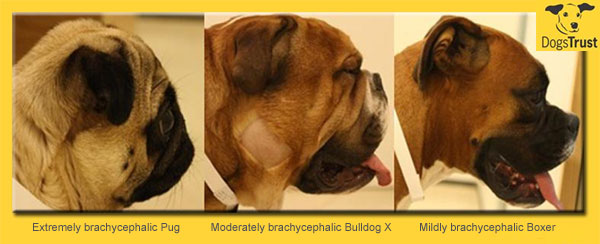
Although short muzzles are an increasingly popular face shape in pet dogs, flattened faces have been shown to greatly increase the risk of developing a debilitating, lifelong respiratory condition which leaves the dogs chronically short of breath. Breeds shown to be at high risk include the Pug, French Bulldog and English Bulldog, but findings are relevant to all dogs with shortened muzzles.
What is BOAS?
Brachycephalic Obstructive Airway Syndrome (BOAS) is caused by shortening of the bones of the canine muzzle, without an equivalent reduction in the soft tissues held within them, causing the tissue to become ‘crammed’ within the skull. This tissue can block the airway, and is often accompanied by narrowed nostrils, making it difficult for air to pass through the dog’s nose. These blockages can mean dogs struggle to breathe, leaving them unable to exercise, play or eat normally, and in some cases they overheat and collapse. BOAS can even cause early death. Dogs with BOAS often snore even while awake, when the soft tissue noisily vibrates as dogs force air through.
Video – Bulldog with BOAS
The researchers found that as muzzle length becomes shorter, risk of BOAS becomes higher, with over 90% of dogs being affected at the shortest extreme. This quality-of-life limiting disorder was only seen in dogs whose muzzles were less than half the length of the domed part of the skull. Obesity and thicker necks also increased BOAS risk.
What dog owners need to know
Decreasing muzzle length increases the risk of BOAS. Dog owners and those buying or breeding puppies need to be aware of the health consequences of selecting dogs based on appearance.
Practical steps to take when buying a dog of a high-risk breed include selecting puppies from parents with longer muzzles and slimmer necks, and ensuring their dog stays at a healthy body weight. Look beyond appealing appearances and listen for the audible signs of BOAS.
Breeding organisations should actively discourage exaggeration of this high-risk skull shape in both breed standards and the show ring. This could include imposing limits to how short a dogs muzzle can be, in order to improve dog welfare.
Veterinary Director for the Dogs Trust, Paula Boyden, explains the importance of this research:
“The increased popularity of Pugs, French and English Bulldogs hasn’t been coupled with an increased awareness about the health issues these breeds can suffer from. Too many people mistakenly believe that the grunting, snuffling and wheezing sounds these breeds often make are endearing breed traits, rather than warnings of a debilitating health condition. Dogs Trust urges owners to be vigilant for the signs their dog might be suffering with BOAS and take their pet to the vet for advice if they have concerns. The condition cannot be cured but can be improved and there may be things that can be done to provide a better a quality of life for affected dogs.”
The signs of BOAS
Signs to look out for that your dog might be suffering from BOAS:
- Frequent or lasting shortness of breath
- Difficulties in walking, running and playing as a result of shortness of breath
- A tendency to overheat
- Respiratory noises such as snorting and snoring, even when awake
- Laboured or exaggerated breathing
- Narrow slit-like nostrils
If you do have a dog at risk of the condition make sure they maintain a healthy weight because obesity can worsen BOAS.
Resources and further reading
UFAW, an independent charity which promotes advances in animal welfare through scientific and educational activities, has an extensive web-based information resource on genetic welfare problems in dogs and other companion animals www.ufaw.org.uk
Main resource https://www.dogstrust.org.uk/whats-happening/news/research-shows-high-risk-of-breathing-problems-in-dogs-with-short-muzzles
* The research was co-funded by Dogs Trust and the UFAW. It involved two studies including over 850 dogs of over 100 breeds. The findings were reported in a paper by Drs Rowena Packer, Anke Hendricks, Michael Tivers and Charlotte Burn. The full report can be found here Impact of Facial Conformation on Canine Health: Brachycephalic Obstructive Airway Syndrome.